

Engaged Learning for Empowered Futures
Deacs Do … transformational education. We prepare our students to think critically, solve real-world problems, and carry forward the spirit of Pro Humanitate.
Deacs Do… expansive experiential learning opportunities across all disciplines. Together, we build on what we already do well — mentored research, community partnerships, and project-based learning — and reimagine what’s possible for our students’ future.
Deacs Do … collective effort and interdisciplinarity. Faculty and staff across disciplines play a crucial role in shaping the vision, practices, and impact of experiential learning.
Why Deacs Do Experiential Learning

Experiential learning changes the way students learn — and who they become.
When we teach this way, students don’t just graduate with knowledge — they graduate with wisdom, resilience, and a deep sense of purpose.
Gain confidence
and perspective
by navigating ambiguity and working with others.
Bridge theory
and practice
by applying knowledge in complex, real-world contexts.
Co-create
knowledge
through inquiry, creativity, and collaboration.
Live out
Pro Humanitate
by working alongside communities, industries, and partners.
See What Deacs Do
- Deacs Do: Senya Li (’28)
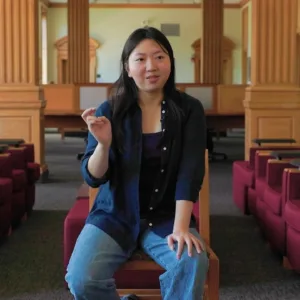 In Summer 2026, through a Wake Forest Arts and Humanities Research Fellowship, Senya Li (’28) worked alongside mentor Dr. Cindy Gendrich, professor of Theatre, to explore the stories behind “The […]
 - Deacs Do: Fedelia Ashie (’29)
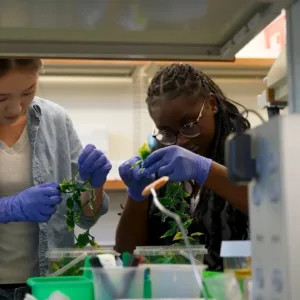 In Summer 2026, Fedelia Ashie (’29) worked alongside Jacob Barrett (Ph.D. ’27) in the Currie Lab to study how axolotls regenerate and why similar processes in humans lead to scarring. […]
 - Deacs Do: Leyla Herrera (’27)
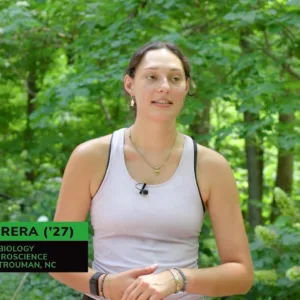 For Leyla Herrera (’27), summer research means taking science beyond the classroom and into the field. At the Emily Allen Wildflower Preserve, Leyla studied how ferns function in different environments, […]
 - Deacs Do: Andrew Riggs (’27)
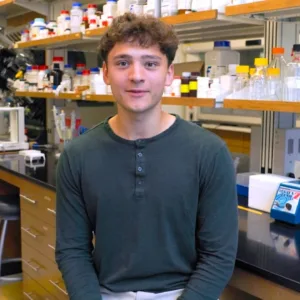 Discovering new cancer treatments starts with curiosity and the next generation of researchers. During the summer of 2026, undergraduate Andrew Riggs (’27) is working alongside Wake Forest professor Ulrich Bierbach […]
 - Deacs Do: Lacy February (’27)
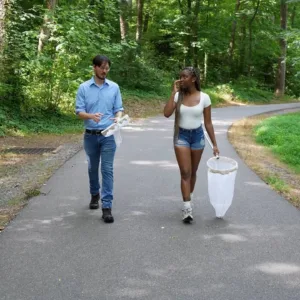 During Summer 2026, biochemistry and molecular biology major Lacy February (‘27) worked alongside biology professor Chris Jernigan through Wake Forest’s URECA program to study how northern paper wasps recognize one […]