- Experiential Learning in Theatre: Harold Pinter’s Old Times and Memory
For months, students in Wake Forest’s Theatre Department have been reflecting on memories: what they are, how they show up in daily life, and what it means for one’s memory to be distorted by the present.
In Harold Pinter’s Old Times, directed by Dr. Cindy Gendrich, Professor of Theatre, students engage with these themes in a way that extends far beyond memorizing lines and rehearsing choreography. As a psychology major with minors in neuroscience and theatre, Assistant Director Nancy Huang (’27) invites the whole team — from the cast members to the stage crew — to explore the play from an interdisciplinary approach, bridging research with the embodied experience of bringing a character to life on stage. The result is a powerful production that connects classroom learning with real, lived experience.
- Senior Eli Leadham Wins Prestigious Schwarzman Scholarship
Eli Leadham has been named a Schwarzman Scholar, one of just 150 students worldwide to pursue a fully-funded master’s program in global affairs at Tsinghua University. A sociology major from Portland, Oregon, Leadham plans to spend the year abroad advocating for transitional justice and human rights on a global scale.
- Dr. Smith’s Black Entrepreneurship Course Connects Students with Community Leaders for Real-World Engagement
Brave Spaces, Entrepreneurship, and Food. These are the words at the heart of Dr. Ariel D. Smith’s course, “Black Entrepreneurship in America” (ENT 304C).
An elective in the Center for Entrepreneurship, the class tells United States history through the lens of Black entrepreneurs, whose contributions and experiences helped lay the foundation of entrepreneurship in America today.
- Research Day showcases how functional materials shape a better future
On the surface, the posters lining the walls of Benson 410 at Wake Forest’s third annual Center for Functional Materials (CFM) Research Day looked like the typical trappings of an academic showcase: charts, microscopy images, material diagrams, lines of data. But a closer look revealed something deeper. These projects—ranging from nanomaterials for cancer detection to thin-film technologies for improved solar cells—represent the quiet engines of innovation that shape how we communicate, generate energy, heal, and live.
- Professor Megan Bennett launches ambitious SPICE-D study to address food insecurity
For nearly four years, Megan Bennett has served as an assistant professor in Health and Exercise Science at Wake Forest. Yet her commitment to public health—and her two decades of research on chronic disease interventions—extends far beyond the classroom. This month, she’s launching her most ambitious project yet: Supporting People through Inclusive Cultural Eating for Diabetes, or SPICE-D. Bennett recently received an Academic Community Engagement (ACE) Fellowship(opens in a new tab), which will provide targeted support for the SPICE-D project.

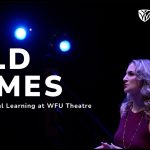 For months, students in Wake Forest’s Theatre Department have been reflecting on memories: what they are, how they show up in daily life, and what it means for one’s memory to be distorted by the present. In Harold Pinter’s Old Times, directed by Dr. Cindy Gendrich, Professor of Theatre, students engage with these themes in a way that extends far beyond memorizing lines and rehearsing choreography. As a psychology major with minors in neuroscience and theatre, Assistant Director Nancy Huang (’27) invites the whole team — from the cast members to the stage crew — to explore the play from an interdisciplinary approach, bridging research with the embodied experience of bringing a character to life on stage. The result is a powerful production that connects classroom learning with real, lived experience.
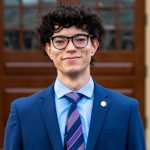 Eli Leadham has been named a Schwarzman Scholar, one of just 150 students worldwide to pursue a fully-funded master’s program in global affairs at Tsinghua University. A sociology major from Portland, Oregon, Leadham plans to spend the year abroad advocating for transitional justice and human rights on a global scale.
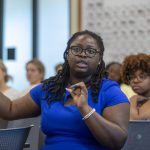 Brave Spaces, Entrepreneurship, and Food. These are the words at the heart of Dr. Ariel D. Smith’s course, “Black Entrepreneurship in America” (ENT 304C). An elective in the Center for Entrepreneurship, the class tells United States history through the lens of Black entrepreneurs, whose contributions and experiences helped lay the foundation of entrepreneurship in America today.
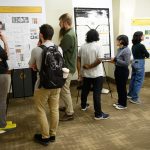 On the surface, the posters lining the walls of Benson 410 at Wake Forest’s third annual Center for Functional Materials (CFM) Research Day looked like the typical trappings of an academic showcase: charts, microscopy images, material diagrams, lines of data. But a closer look revealed something deeper. These projects—ranging from nanomaterials for cancer detection to thin-film technologies for improved solar cells—represent the quiet engines of innovation that shape how we communicate, generate energy, heal, and live.
 For nearly four years, Megan Bennett has served as an assistant professor in Health and Exercise Science at Wake Forest. Yet her commitment to public health—and her two decades of research on chronic disease interventions—extends far beyond the classroom. This month, she’s launching her most ambitious project yet: Supporting People through Inclusive Cultural Eating for Diabetes, or SPICE-D. Bennett recently received an Academic Community Engagement (ACE) Fellowship(opens in a new tab), which will provide targeted support for the SPICE-D project.